After Donald Trump and Benjamin Netanyahu urged Iranians to rise up against the ayatollahs' regime, authorities deployed Revolutionary Guards and Basij...
Ynetnews
Saturday, March 7, 2026 4:11:24 AM
Iran intensifies protest crackdown amid war: ‘The real enemy is the people’
After Donald Trump and Benjamin Netanyahu urged Iranians to rise up against the ayatollahs’ regime, authorities deployed Revolutionary Guards and Basij forces to the streets, setting up checkpoints and searching civilians as residents say fear now prevents protests
Following the war, Tehran’s traffic-clogged roads have emptied of cars, replaced instead by checkpoints and security forces as Iran’s regime tightens its grip on its citizens.
Supreme Leader Ayatollah Ali Khamenei was eliminated in the opening strike of the war last Saturday. Israel and the United States urged Iranians to seize the moment, rise up against the regime and overthrow it, but the government quickly suppressed celebrations by its opponents over Khamenei’s death and the possibility of a new wave of protests.
Over the past week, Iranians have found themselves trapped between attacks by Israel and the United States and repression by their own government. Authorities have deployed large numbers of security forces in the streets and shut down the internet, isolating citizens from the outside world.
A 30-year-old Iranian living in Tehran told AFP that the Islamic Revolutionary Guard Corps had “closed almost every major street with gunmen carrying heavy machine guns to frighten people.” According to him, in the eyes of the Revolutionary Guards “the real enemy is the people, not the Americans. The extremists (in the Revolutionary Guards) say that first we must deal with the enemy at home.”
The campaign against Iran began several weeks after a massive wave of protests against the regime that peaked in January, when crowds took to the streets chanting “Death to Khamenei.” The regime brutally suppressed the demonstrations and, according to some reports, killed tens of thousands of people. In recent days, pro-government demonstrations have been held — seen as an attempt by the authorities to prevent new protests by opponents.
Residents of Tehran told AFP that many of the security personnel in the streets belong to the Basij, the volunteer militia subordinate to the Revolutionary Guards that is tasked with maintaining public order. They have set up checkpoints together with members of the Revolutionary Guards and the police to search vehicles and conduct body searches. “There are no traffic jams except those created by the Revolutionary Guards with temporary checkpoints on every corner,” the 30-year-old Tehran resident said.
Amir, a 40-year-old from Tehran, said that since Khamenei’s death, plainclothes security agents “are everywhere in the streets, and they are all armed — so we cannot demonstrate right now. They have taken over the places that belonged to the public.”
An engineer living in Tehran told the French news agency that security forces are “roaming the streets on their own, spreading fear, checking people’s phones and harassing residents.”
Tensions are also being felt on Kish Island in the Persian Gulf. A resident of the Iranian island said that “people hardly dare leave their homes anymore,” except to buy food. According to him, “military rule” has been in effect on the island since 6 p.m.
Pierre Razoux, research director at the Mediterranean Foundation for Strategic Studies, told French lawmakers on Wednesday that Iran’s regime possesses a vast internal security apparatus including “850,000 agents of repression.” He said the Basij alone has about 600,000 members — “more than the regular army and the Revolutionary Guards combined.” Human rights groups have warned that repression in Iran could intensify during the war, harming the chances of a popular uprising encouraged by Donald Trump and Benjamin Netanyahu.
“The main existential threat to the Islamic Republic is not airstrikes but Iranians taking to the streets,” said Mahmood Amiry-Moghaddam, head of the Iran Human Rights organization. “The Islamic Republic’s supreme goal is to protect itself, so there is a risk we may face new massacres, mass arrests and mass executions.”
When the war began, Iran’s regime shut down the internet and warned that anyone circumventing the block using VPN services could face prosecution. On Thursday the Intelligence Ministry warned that anyone filming near “sensitive locations” could be considered a foreign agent and urged citizens to report them.
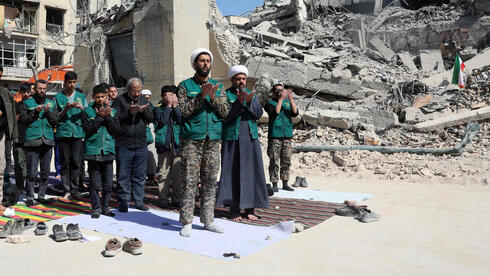
A resident of the city of Shiraz said regime forces suppressed celebrations over Khamenei’s death after he was killed last weekend. A day after the celebrations were dispersed, people identified as regime supporters gathered in Shiraz streets in a government-approved assembly. State television broadcast numerous pro-regime rallies, in which crowds waved the Iranian flag and mourned Khamenei’s death.
These days, Tehran residents can still be heard at night shouting against the regime from their apartment windows. They hope that soon they will return to the streets. “We stay at home and hope to remain alive so we can truly dance when we are free,” said Elnaz, a 39-year-old from Tehran.
Original Source:
Ynetnews
Visit Link