From Afghanistan, Iraq and now Iran, the symbol of the veiled, 'oppressed' Muslim woman is strategically deployed when it suits US foreign policy.
Scroll.in
Saturday, March 7, 2026 7:09:13 AM
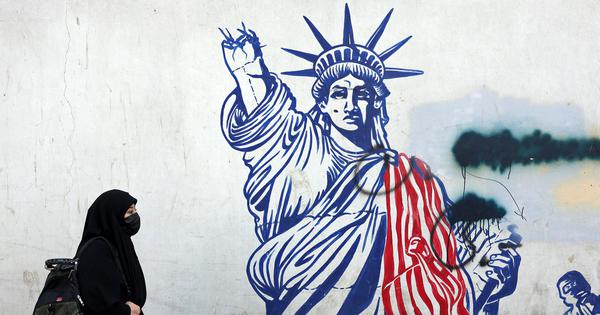
‘Saving Muslim women’ puts the feminist gloss on the self-serving wars of Western democracies
The assassination of Iranian supreme leader Ayatollah Ali Khamenei and the possible end of the Islamic regime is being perceived and discussed as particularly beneficial for Iranian women. In joint strikes on February 28, the US and Israel attacked Iran, killing Khamenei and other senior leaders in the country, setting off a broader confrontation in West Asia.
On social media and in the news, videos and posts claim to show women especially, dancing and celebrating Khamenei’s death. The undertone is that the US and Israel are now the saviours of Iran and especially Iranian women – even as the strikes bombed a primary school in Iran, killing at least 165 people, most of them girls between the ages of seven to 12. As of March 5, Iran’s death toll had crossed 1,000, according to a local news agency.
Such gendered narratives have a long history.
For instance, a series of widely circulated images compare “women in Iran in the 1970s”, dressed stylishly in short skirts and dresses, their hair free, with images of women after the 1979 Iranian Revolution, in black chadors or headscarves. Among the most popular of these images is one showing women sitting in a public space, their legs bare and hair open.
But this is disingenuous. It ignores the reality that the regime under pro-American Mohammad Reza Pahlavi, the last Shah of Iran, was deeply unpopular, even brutally repressive, until it was overthrown.
Veiling and unveiling, say scholars, had more to do with how Iran negotiated Western modernity over the course of the 20th century amid British colonial influence and American ambition in the region. Reducing veiling to an embrace of religious fundamentalism does not account for the anti-imperialist and anti-Western sentiment that drove the Iranian Revolution.
Besides, Iranian women have tried to resist veiling and coercive punishments for flouting dress and morality codes in the country for decades, often at great cost to their lives. Saviour narratives by Western countries appropriate this resistance and undermine women’s agency as political actors.
When it serves American foreign policy, the symbol of the veiled and “oppressed” Muslim woman has been deployed to rally support for and justify military interventions in Afghanistan and Iraq and now in Iran.
In August 2021, as the Taliban seized Afghanistan following the retreat of the US forces after a failed 20-year-war, a widely circulated image “Women in Afghanistan, 1972” showed smartly dressed women wearing skirts walking down an avenue. It drew on years of news media coverage and political rhetoric shaped by America’s post-9/11 “war on terror”.
In such picture essays, often published by the BBC and other English and American news organisations, the veiled Muslim woman is contrasted with the unveiled woman in the “past”, as if to show that Islamic regimes are inherently misogynistic. The burqa or veiling is portrayed as a manifestation of a violent and religious patriarchal culture, thrust on helpless Muslim women while Arab and Muslim men are typecast as sexually rapacious.
Feminism and women’s rights, such narratives seem to say, can only be guaranteed by Western liberal democracies under the protection of their military might. It is an extension of how powerful Western countries, as colonising empires in the past, framed their brutal and dispossessing conquests around the world as civilising missions that would improve the lives of natives.
Literary scholar Teresa Heffernan, in her book Veiled Figures, writes that “the desire to ‘save’ the Eastern woman from her own culture, a gesture that inevitably involves unveiling her, has a long history in the West, a history that has little to do with women’s freedom or rights.”
Indeed, there has been little effort to save Muslim women from Israel’s devastating military assault on the Gaza Strip, underway since October 2023, which UN bodies are now describing as a genocide and ethnic cleansing. Instead, Israel depicts itself as West Asia’s sanctuary for queer rights and democracy while being surrounded by religiously conservative countries ruled by autocrats.
American anthropologist Lila Abu-Lughod in Do Muslim Women Need Saving has criticised how the resort to cultural framing prevents a serious examination of historical and political explanations for conflicts in West Asia and especially the complicity of the United States in destabilising the region. “Instead we were offered ones that worked to artificially divide the world into separate spheres – re-creating an imaginative geography of West versus East, us versus Muslims..,” writes Abu-Lughod.
This time, the United States is being refreshingly honest but there is little solace in that. In a press briefing on March 2, Pete Hegseth, the bellicose US Secretary of War, said, “This is not Iraq. This is not endless.”
Over the last couple of years, there has been a damning and harsh reckoning of America’s invasion of Afghanistan in 2001 and then Iraq in 2003. Shifting goalposts of destroying Iraq’s stockpile of nuclear weapons, building up democracy in Afghanistan and Iraq and, most prominently, saving Muslim women from repressive Islamic regimes and the oppressive burqa, have crumbled and been emphatically disproven – “A Bloody Delusion”, is how The Guardian headlined an article marking 20 years of the Iraq invasion in 2023.
The attack on Iran, nearly 25 years later, is none of that, Hegseth insisted: “No stupid rules of engagement, no nation-building quagmire, no democracy building exercise, no politically correct wars.”
The irony this time is that the US has no need for the fig leaf of democracy or women’s rights and gender when the Trump administration cares little for either and is actively undermining both within its own country.
More than two decades later, the words of the Revolutionary Association of the Women of Afghanistan, issued on Women’s Day in March 2004, come to mind: the freedom of a nation is to be achieved by itself – similarly, the real emancipation of women can be realised only by themselves. If that freedom is bestowed by others, it may be seized and violated any time.
We welcome your comments at letters@scroll.in.
* Iran
* Gender
* United States
* Afghanistan
Original Source:
Scroll.in
Visit Link